Atnaujinkite slapukų nuostatas

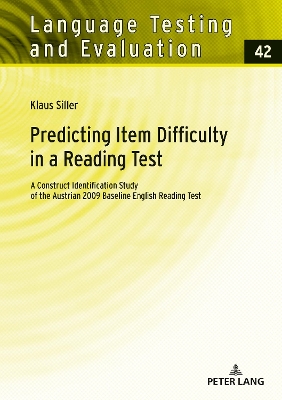
El. knyga: Predicting Item Difficulty in a Reading Test: A Construct Identification Study of the Austrian 2009 Baseline English Reading Test

Series edited by ,
Kitos knygos pagal šią temą:

DRM apribojimai

  • Kopijuoti:

    neleidžiama

  • Spausdinti:

    neleidžiama

  • El. knygos naudojimas:

    Skaitmeninių teisių valdymas (DRM)
    Leidykla pateikė šią knygą šifruota forma, o tai reiškia, kad norint ją atrakinti ir perskaityti reikia įdiegti nemokamą programinę įrangą. Norint skaityti šią el. knygą, turite susikurti Adobe ID . Daugiau informacijos  čia. El. knygą galima atsisiųsti į 6 įrenginius (vienas vartotojas su tuo pačiu Adobe ID).

    Reikalinga programinė įranga
    Norint skaityti šią el. knygą mobiliajame įrenginyje (telefone ar planšetiniame kompiuteryje), turite įdiegti šią nemokamą programėlę: PocketBook Reader (iOS / Android)

    Norint skaityti šią el. knygą asmeniniame arba „Mac“ kompiuteryje, Jums reikalinga  Adobe Digital Editions “ (tai nemokama programa, specialiai sukurta el. knygoms. Tai nėra tas pats, kas „Adobe Reader“, kurią tikriausiai jau turite savo kompiuteryje.)

    Negalite skaityti šios el. knygos naudodami „Amazon Kindle“.

"In this book, the author investigates a central issue in language testing research: What are the key features that contribute to item difficulty in a reading test? Results of various statistical analyses of the multiple-choice reading items from the Austrian 2009 baseline reading test show a significant correlation between empirical item difficulty and both cognitive processes and metacognitive strategies. The findings thus provide evidence of the construct validity of the baseline reading test on the one hand, but are equally relevant to teaching practices on the other hand. The teaching of reading at lower secondary level in the Austrian context needs to focus more on cognitive processes of different complexity and the active teaching of metacognitivereading strategies"--
Abbreviations 11(2)
1 Introduction
13(6)
1.1 The Background to the Study
13(2)
1.2 The Research Objectives
15(1)
1.3 The Structure of the Publication
16(3)
2 Political and Historical Context
19(26)
2.1 The Development of Educational Standards in Austria
19(1)
2.2 Developing Standard-Based Assessment Tasks
20(6)
2.2.1 E8 Test Purpose
21(1)
2.2.2 E8 Test Constructs
21(3)
2.2.3 E8 Item Development
24(1)
2.2.4 Reporting Results
25(1)
2.3 The E8 Baseline Reading Test
26(19)
2.3.1 Contextual and Situational Constraints
27(1)
2.3.2 Construct Definition
27(4)
2.3.3 Operationalisation
31(12)
2.3.4 Interpreting and Reporting Test Results
43(2)
3 Approaches to Language Test Validation
45(16)
3.1 Content Validity
46(1)
3.2 Criterion-Related Validity
47(1)
3.3 Construct Validity
48(1)
3.4 Face Validity
49(1)
3.5 Unitary Concepts of Validity
50(2)
3.6 Operational Frameworks
52(9)
4 Item Content Analysis
61(64)
4.1 Denning and Modelling Reading Comprehension
61(12)
4.1.1 Bottom-Up Models
64(1)
4.1.2 Top-Down Models
65(2)
4.1.3 Interactive Models
67(2)
4.1.4 Componential Models
69(1)
4.1.5 A Cognitive Processing Model for Reading Comprehension
70(3)
4.2 Potential Predictors of Item Difficulty
73(26)
4.2.1 Contextual Features Affecting Reading Comprehension
82(12)
4.2.2 Cognitive Reading Processes as Potential Predictors of Item Difficulty
94(5)
4.3 Operationalisation of Predictor Variables
99(26)
5 Statistical Analyses
125(6)
5.1 Relationships Among Item Content Variables
125(1)
5.2 Content Characteristics and Empirical Difficulty
126(5)
5.2.1 Data
126(1)
5.2.2 Methods
127(4)
6 Results
131(18)
6.1 Simple Regression Analyses
131(3)
6.2 Analyses of Variance
134(9)
6.3 Multiple Regression Models
143(6)
7 Conclusion
149(10)
7.1 Answers to the Research Questions
149(7)
7.2 Limitations and Suggestions for Further Research
156(3)
Appendices 159(32)
List of Figures 191(2)
List of Tables 193(4)
References 197
Klaus Siller is a Senior Lecturer in English as a Foreign Language in the English Department at the Salzburg University of Education Stefan Zweig. His research interests are in all areas of foreign language teacher education and particularly in foreign language testing and assessment.