Atnaujinkite slapukų nuostatas

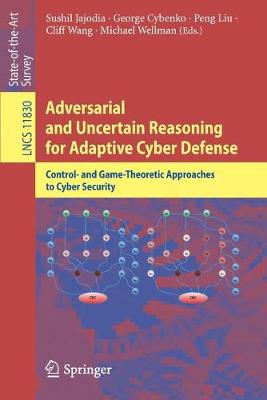
El. knyga: Adversarial and Uncertain Reasoning for Adaptive Cyber Defense: Control- and Game-Theoretic Approaches to Cyber Security

Edited by , Edited by , Edited by , Edited by , Edited by
  • Formatas: EPUB+DRM
  • Serija: Lecture Notes in Computer Science 11830
  • Išleidimo metai: 30-Aug-2019
  • Leidėjas: Springer Nature Switzerland AG
  • Kalba: eng
  • ISBN-13: 9783030307196
  • Formatas: EPUB+DRM
  • Serija: Lecture Notes in Computer Science 11830
  • Išleidimo metai: 30-Aug-2019
  • Leidėjas: Springer Nature Switzerland AG
  • Kalba: eng
  • ISBN-13: 9783030307196

DRM apribojimai

  • Kopijuoti:

    neleidžiama

  • Spausdinti:

    neleidžiama

  • El. knygos naudojimas:

    Skaitmeninių teisių valdymas (DRM)
    Leidykla pateikė šią knygą šifruota forma, o tai reiškia, kad norint ją atrakinti ir perskaityti reikia įdiegti nemokamą programinę įrangą. Norint skaityti šią el. knygą, turite susikurti Adobe ID . Daugiau informacijos  čia. El. knygą galima atsisiųsti į 6 įrenginius (vienas vartotojas su tuo pačiu Adobe ID).

    Reikalinga programinė įranga
    Norint skaityti šią el. knygą mobiliajame įrenginyje (telefone ar planšetiniame kompiuteryje), turite įdiegti šią nemokamą programėlę: PocketBook Reader (iOS / Android)

    Norint skaityti šią el. knygą asmeniniame arba „Mac“ kompiuteryje, Jums reikalinga  Adobe Digital Editions “ (tai nemokama programa, specialiai sukurta el. knygoms. Tai nėra tas pats, kas „Adobe Reader“, kurią tikriausiai jau turite savo kompiuteryje.)

    Negalite skaityti šios el. knygos naudodami „Amazon Kindle“.

Todays cyber defenses are largely static allowing adversaries to pre-plan their attacks. In response to this situation, researchers have started to investigate various methods that make networked information systems less homogeneous and less predictable by engineering systems that have homogeneous functionalities but randomized manifestations.


The 10 papers included in this State-of-the Art Survey present recent advances made by a large team of researchers working on the same US Department of Defense Multidisciplinary University Research Initiative (MURI) project during 2013-2019. This project has developed a new class of technologies called Adaptive Cyber Defense (ACD) by building on two active but heretofore separate research areas: Adaptation Techniques (AT) and Adversarial Reasoning (AR). AT methods introduce diversity and uncertainty into networks, applications, and hosts. AR combines machine learning, behavioral science, operations research, control theory, and gametheory to address the goal of computing effective strategies in dynamic, adversarial environments.



Overview of Control and Game Theory in Adaptive Cyber Defenses
1(11)
George Cybenko
Michael Wellman
Peng Liu
Minghui Zhu
Control-Theoretic Approaches to Cyber-Security
12(17)
Erik Miehling
Mohammad Rasouli
Demosthenis Teneketzis
Game Theoretic Approaches to Cyber Security: Challenges, Results, and Open Problems
29(25)
Hamidreza Tavafoghi
Yi Ouyang
Demosthenis Teneketzis
Michael P. Wellman
Reinforcement Learning for Adaptive Cyber Defense Against Zero-Day Attacks
54(40)
Zhisheng Hu
Ping Chen
Minghui Zhu
Peng Liu
Moving Target Defense Quantification
94(18)
Massimiliano Albanese
Warren Connell
Sridhar Venkatesan
George Cybenko
Empirical Game-Theoretic Methods for Adaptive Cyber-Defense
112(17)
Michael P. Wellman
Thanh H. Nguyen
Mason Wright
MTD Techniques for Memory Protection Against Zero-Day Attacks
129(27)
Ping Chen
Zhisheng Hu
Jun Xu
Minghui Zhu
Rob Erbacher
Sushil Jajodia
Peng Liu
Adaptive Cyber Defenses for Botnet Detection and Mitigation
156(50)
Massimiliano Albanese
Sushil Jajodia
Sridhar Venkatesan
George Cybenko
Thanh Nguyen
Optimizing Alert Data Management Processes at a Cyber Security Operations Center
206(26)
Rajesh Ganesan
Ankit Shah
Sushil Jajodia
Hasan Cam
Online and Scalable Adaptive Cyber Defense
232(31)
Benjamin W. Priest
George Cybenko
Satinder Singh
Massimiliano Albanese
Peng Liu
Author Index 263