Atnaujinkite slapukų nuostatas

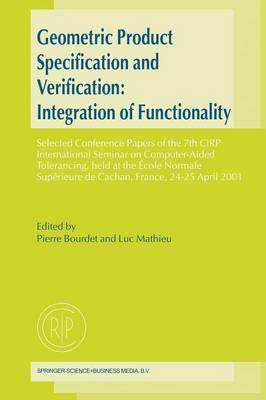
Geometric Product Specification and Verification: Integration of Functionality: Selected Conference Papers of the 7th CIRP International Seminar on Computer-Aided Tolerancing, held at the École Normale Supérieure de Cachan, France, 2425 April 2001 Softcover reprint of hardcover 1st ed. 2003 [Minkštas viršelis]

Edited by , Edited by
  • Formatas: Paperback / softback, 324 pages, aukštis x plotis: 297x210 mm, weight: 893 g, XIV, 324 p., 1 Paperback / softback
  • Išleidimo metai: 01-Dec-2010
  • Leidėjas: Springer
  • ISBN-10: 9048163420
  • ISBN-13: 9789048163427
Kitos knygos pagal šią temą:
  • Formatas: Paperback / softback, 324 pages, aukštis x plotis: 297x210 mm, weight: 893 g, XIV, 324 p., 1 Paperback / softback
  • Išleidimo metai: 01-Dec-2010
  • Leidėjas: Springer
  • ISBN-10: 9048163420
  • ISBN-13: 9789048163427
Kitos knygos pagal šią temą:
This book focuses in particular on Geometrical Product Specification and Verification which is an integrated tolerancing view and metrology proposed for ISO/TC213. Common geometrical bases for a language allowing to describe both functional specification and inspection procedures are provided. An extended view of the uncertainty concept is also given. Geometric Product Specification and Verification: Functionality Integration is an excellent resource to anyone interested in computer aided tolerancing, as well as CAD/CAM/CAQ. It can also be used as a good starting point for advanced research activity and is a good reference for industrial issues. A global view of geometrical product specification, models for tolerance representation, tolerance analysis, tolerance synthesis, tolerance in manufacturing, tolerance management, tolerance inspection, tolerancing standards, industrial applications and CAT systems are also included.

Daugiau informacijos

Springer Book Archives
Geometrical Product Specification: ISO, research and industrial views.-
An Integrated View of Geometrical Product Specification and Verification.-
Global view of geometrical specifications.- 3D Functional Tolerancing &
Annotation: CATIA tools for Geometrical Product Specification.- Model for
tolerance representation.- Areal Coordinates: The Basis of a Mathematical
Model for Geometric Tolerances.- Curves for Profile Tolerance zone
boundaries.- Representation of tolerances using fuzzy Logic.- Tolerance
analysis.- Determination of relative situations of parts for tolerance
computation.- Genetic Algorithms for TTRS tolerance analysis.- Calculation of
virtual and resultant parts for variational assembly analysis.- 3D Tolerances
Analysis, from Preliminary Study.- Statistical Tolerance Analysis Using
GapSpace.- Analysis of functional geometrical specification.- Simultaneous
analysis method for tolerancing flexible mechanisms.- Tolerance synthesis.-
Towards robust kinematic synthesis of mechanical systems.- Tolerance analysis
and synthesis by means of clearance and deviation spaces.- Synthesis of
tolerances starting from a fuzzy expression of the functional requirements.-
Tolerance in manufacturing.- An Accurate Fixture Model for Precision
Fixturing.- An analytical approach to machining deviation due to fixturing.-
Three-dimensional geometrical tolerancing: quantification of machining
defects.- Process plan validation including process deviations and
machine-tool errors.- Tolerance management.- Framework proposal for a modular
approach to tolerancing.- Method for Geometric Variation Management from Key
Characteristics to Specification.- Tolerance verification.- Geometrical
tolerancing using linear programming: functional approach and specification
of application domain.- Contribution of nonlinear optimization to the
determination of measurement uncertainties.- Probabilistic evaluation of
invariant surfaces through the Parzens method.- Industrial applications and
CAT systems.- Automated Seam Variation and Stability Analysis for Automotive
Body Design.- Functional assistance for computer-aided tolerancing software.-
Towards a Method for Early Evaluations of Sheet Metal Assemblies.- An
assisted method for specifying ISO tolerances applied to structural
assemblies.- Toward non-nominal virtual geometric verification by combining
VR and CAT technologies.- Tolerancing Standard.- A STEP Translator toward
Computer Integrated Tolerancing.