Atnaujinkite slapukų nuostatas

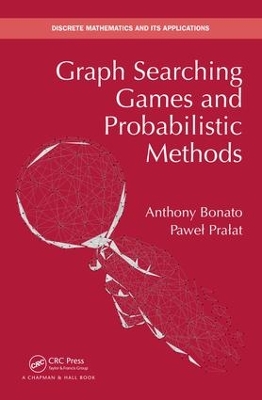
El. knyga: Graph Searching Games and Probabilistic Methods

DRM apribojimai

  • Kopijuoti:

    neleidžiama

  • Spausdinti:

    neleidžiama

  • El. knygos naudojimas:

    Skaitmeninių teisių valdymas (DRM)
    Leidykla pateikė šią knygą šifruota forma, o tai reiškia, kad norint ją atrakinti ir perskaityti reikia įdiegti nemokamą programinę įrangą. Norint skaityti šią el. knygą, turite susikurti Adobe ID . Daugiau informacijos  čia. El. knygą galima atsisiųsti į 6 įrenginius (vienas vartotojas su tuo pačiu Adobe ID).

    Reikalinga programinė įranga
    Norint skaityti šią el. knygą mobiliajame įrenginyje (telefone ar planšetiniame kompiuteryje), turite įdiegti šią nemokamą programėlę: PocketBook Reader (iOS / Android)

    Norint skaityti šią el. knygą asmeniniame arba „Mac“ kompiuteryje, Jums reikalinga  Adobe Digital Editions “ (tai nemokama programa, specialiai sukurta el. knygoms. Tai nėra tas pats, kas „Adobe Reader“, kurią tikriausiai jau turite savo kompiuteryje.)

    Negalite skaityti šios el. knygos naudodami „Amazon Kindle“.

Graph Searching Games and Probabilistic Methods is the first book that focuses on the intersection of graph searching games and probabilistic methods. The book explores various applications of these powerful mathematical tools to games and processes such as Cops and Robbers, Zombie and Survivors, and Firefighting.

Written in an engaging style, the book is accessible to a wide audience including mathematicians and computer scientists. Readers will find that the book provides state-of-the-art results, techniques, and directions in graph searching games, especially from the point of view of probabilistic methods.


The authors describe three directions while providing numerous examples, which include:

Playing a deterministic game on a random board.

Players making random moves.

Probabilistic methods used to analyze a deterministic game.

Recenzijos

"Pursuit-evasion games is an exciting branch of graph theory, with many innocent looking problems that are very dicult to solve. Written by two experts in this lively area, this book surveys the state-of-the-art results in this area and explains the most important ideas in an engaging manner. Another important theme in this book is probabilistic methods; through fascinating and fun graph searching games, the book covers quite a range of important tools from probabilistic methods and random graphs.

This book is fun to read, accessible to students as well as to researchers, and it is an attractive resource for everyone who wants to enter any of these three areas: graph searching games, probabilistic methods, or random graphs. It can also be used as the textbook for a graduatecourse on these topics."

Abbas Mehrabian (Montreal)

List of Figures
xiii
List of Tables
xvii
Preface xix
1 Introduction
1(28)
1.1 Graphs
2(5)
1.2 Probability
7(5)
1.3 Asymptotic Notation and Useful Inequalities
12(3)
1.4 Random Graphs
15(2)
1.5 Tools: First and Second Moment Methods
17(6)
1.6 Tools: Chernoff Bounds
23(6)
2 The game of Cops and Robbers
29(40)
2.1 Binomial Random Graphs
34(3)
2.2 Graphs with a Given Cop Number
37(6)
2.3 Properties of Almost All Cop-Win Graphs
43(4)
2.4 Properties of Almost All k-Cop-Win Graphs
47(9)
2.5 Random Geometric Graphs
56(4)
2.6 Percolated Random Geometric Graphs
60(9)
3 Variations of Cops and Robbers
69(32)
3.1 Playing on Edges
69(4)
3.2 Cops and Fast Robbers
73(3)
3.3 Lazy Cops and Robbers
76(8)
3.4 Cops and Falling Robbers
84(8)
3.5 Containment Game
92(9)
4 Zombies and Survivors
101(24)
4.1 The Cost of Being Undead Can Be High
103(1)
4.2 Cycles
104(3)
4.3 Hypercubes
107(2)
4.4 Toroidal Grids
109(16)
5 Large cop number and Meyniel's conjecture
125(30)
5.1 Upper Bounds for c(n)
127(5)
5.2 Binomial Random Graphs
132(9)
5.3 Random d-Regular Graphs
141(5)
5.4 Meyniel Extremal Families
146(9)
6 Graph cleaning
155(46)
6.1 Tools: Convergence of Moments Method
160(3)
6.2 Binomial Random Graphs
163(7)
6.3 Tools: Pairing Model
170(4)
6.4 Random Regular Graphs
174(3)
6.5 Tools: Differential Equation Method
177(6)
6.6 DE Method in Graph Cleaning
183(9)
6.7 Game Brush Number
192(9)
7 Acquaintance time
201(30)
7.1 Dense Binomial Random Graphs
202(3)
7.2 Sparse Binomial Random Graphs
205(7)
7.3 Is the Upper Bound Tight?
212(3)
7.4 Hypergraphs
215(8)
7.5 Random Geometric Graphs
223(8)
8 Firefighting
231(24)
8.1 Tool: Expander Mixing Lemma
233(1)
8.2 The k = 1 Case
234(5)
8.3 The k > 1 Case
239(8)
8.4 Fighting Constrained Fires in Graphs
247(8)
9 Acquisition Number
255(20)
9.1 Binomial Random Graphs
256(8)
9.2 Random Geometric Graphs
264(5)
9.3 Randomly Weighted Path
269(6)
10 Temporal parameters
275(38)
10.1 Capture Time
275(6)
10.2 Overprescribed Cops and Robbers
281(7)
10.3 Deterministic Burning
288(8)
10.4 Random Burning
296(4)
10.5 Cops and Drunk (but Visible) Robbers
300(6)
10.6 Cops and Drunk (and Invisible) Robbers
306(7)
11 Miscellaneous topics
313(44)
11.1 Toppling Number
313(12)
11.2 Revolutionary and Spies
325(7)
11.3 Robot Crawler
332(9)
11.4 Seepage
341(16)
Bibliography 357(18)
Index 375
Dr. Anthony Bonato is a professor of Mathematics at Ryerson University, whose main research interests are in graph theory and complex networks. He is co-Editor-in-Chief of Internet Mathematics, editor for Contributions to Discrete Mathematics, and Chair of the Pure Mathematics group within the NSERC Discovery Grants Mathematics and Statistics Evaluation Group.

Dr. Pawel Praat is an associate professor at Ryerson University whose main research interests are in graph theory and complex networks. He is the Assistant Director of Industry Liaison at The Fields Institute for Research in Mathematical Sciences, and has pursued collaborations with various industry partners as well as the Government of Canada.