Atnaujinkite slapukų nuostatas

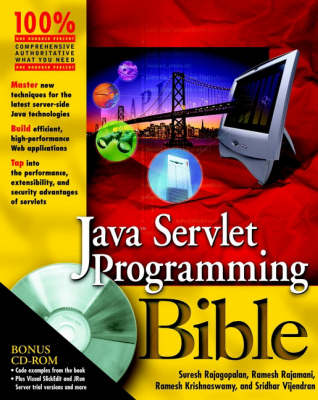
Java Servlet Programming Bible [Minkštas viršelis]

  • Formatas: Paperback / softback, 720 pages, aukštis x plotis: 187x234 mm, weight: 1021 g, Illustrations, Contains 1 Paperback / softback and 1 CD-ROM
  • Išleidimo metai: 01-Mar-2002
  • Leidėjas: Hungry Minds Inc,U.S.
  • ISBN-10: 0764548395
  • ISBN-13: 9780764548390
Kitos knygos pagal šią temą:
  • Formatas: Paperback / softback, 720 pages, aukštis x plotis: 187x234 mm, weight: 1021 g, Illustrations, Contains 1 Paperback / softback and 1 CD-ROM
  • Išleidimo metai: 01-Mar-2002
  • Leidėjas: Hungry Minds Inc,U.S.
  • ISBN-10: 0764548395
  • ISBN-13: 9780764548390
Kitos knygos pagal šią temą:
This book/CD-ROM guide shows how to use Java servlets for improving speed, extensibility, and security. After chapters on servlet programming fundamentals, the bulk of the book covers working with servlets in areas such as HTML, data access, exception handling, RMI, cookies, and servlet communications. Final chapters introduce JavaServer Pages, and appendices cover the servlet API, servlet engines, and JSP syntax. Knowledge of Java programming language basics, HTML, and database concepts is assumed. The accompanying CD-ROM contains Java 2 Software Development Kit, Forte for Java, and trial release versions of Visual SlickEdit and JRun. Rajagopalan is affiliated with the University of Technology-Sydney, Australia. Annotation c. Book News, Inc., Portland, OR (booknews.com)

This book contains all the essential information required for Java Servlet programming at various levels, from simple Web applications to enterprise-wide solutions. Topics include the basics of servlets & servlet programming; HTML and servlets; servlets and databases; JSP basics; the Model View Controller (MVC) Architecture; security, and tips and tricks for the servlet programmer.
Preface ix
Acknowledgments xi
Part I: Servlet Programming Fundamentals 1(106)
Servlets and Web Application Development
3(22)
Setting up a Servlet Development Environment
25(34)
The Servlet Life Cycle
59(20)
Handling HTTP
79(28)
Part II: Working with Servlets 107(296)
Using Servlets with HTML
109(44)
Data Access with Servlets
153(60)
Exception Handling
213(18)
Working with RMI
231(54)
Servlet Communications
285(42)
Building Server-Side Includes
327(20)
Cookies and Session Management
347(46)
Security and Servlets
393(10)
Part III: Beyond Servlets: JavaServer Pages 403(144)
Introducing JSP
405(48)
The Model View Controller (MVC) Architecture
453(66)
Servlets and JSP Tips and Tricks
519(28)
Appendix A: What's on the CD-ROM 547(6)
Appendix B: The Servlet API 553(30)
Appendix C: Servlet Engines 583(4)
Appendix D: JSP Syntax Sheet 587(8)
Appendix E: Elements of the Hypertext Transfer Protocol 595(12)
Appendix F: Apache and Tomcat Configuration 607(32)
Index 639(49)
End-User License Agreement 688
About the Authors Suresh Rajagopalan recently completed his B.S. in Computer Science at the University of Technology Sydney in Australia. His specialty is in eCommerce, which is also his minor. He has worked as a Web and Java developer at the eFunds Corporation in St. Paul, Minnesota. Suresh is also an active member of the Programmers Society of UTS. He wrote Chapters 1, 4, 5, and 10 and Appendixes B, C, and E. He also contributed to Chapter 2 and Appendix D. Ramesh Rajamani is a designer and developer of software products for financial institutions. He has expertise with servlets, JSPs, and J2EE. He is also trains and mentors employees in his company to get them acquainted with the latest Java technologies. Ramesh spends his spare time studying and researching design patterns and their applicability to enterprise Java applications. He wrote Chapters 6, 13, 14, and 15. He also contributed to Chapter 2 and Appendix D. Ramesh Krishnaswamy is a software architect who designs and develops business applications for the financial industry. His prime focus is server--side Java and Enterprise application design. Apart from development, he is involved in training people on Java, enterprise applications, object--oriented technologies, and databases. Ramesh wrote Chapters 8 and 11 and Appendix F, and he also contributed to Chapter 2. Sridhar Vijendran is an ardent computer programmer and a keen chess fanatic. He wrote Chapters 3, 7, 9, and 12.