Atnaujinkite slapukų nuostatas

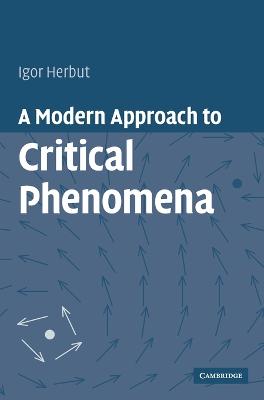
Modern Approach to Critical Phenomena [Kietas viršelis]

(Simon Fraser University, British Columbia)
  • Formatas: Hardback, 220 pages, aukštis x plotis x storis: 253x178x16 mm, weight: 605 g
  • Išleidimo metai: 04-Jan-2007
  • Leidėjas: Cambridge University Press
  • ISBN-10: 0521854520
  • ISBN-13: 9780521854528
Kitos knygos pagal šią temą:
  • Formatas: Hardback, 220 pages, aukštis x plotis x storis: 253x178x16 mm, weight: 605 g
  • Išleidimo metai: 04-Jan-2007
  • Leidėjas: Cambridge University Press
  • ISBN-10: 0521854520
  • ISBN-13: 9780521854528
Kitos knygos pagal šią temą:
Critical phenomena is one of the most exciting areas of modern physics. This book provides a thorough but economic introduction into the principles and techniques of the theory of critical phenomena and the renormalization group, from the perspective of modern condensed matter physics. Assuming basic knowledge of quantum and statistical mechanics, the book discusses phase transitions in magnets, superfluids, superconductors, and gauge field theories. Particular attention is given to modern topics such as gauge field fluctuations in superconductors, the Kosterlitz-Thouless transition, duality transformations, and quantum phase transitions - all of which are at the forefront of today's physics research. This book contains numerous problems of varying degrees of difficulty, with solutions. These problems provide readers with a wealth of material to test their understanding of the subject. It is ideal for graduate students and more experienced researchers in the fields of condensed matter physics, statistical physics, and many-body physics.

Introduction to critical phenomena for graduates and researchers in condensed matter physics and statistical physics.

Recenzijos

Review of the hardback: 'This relatively short and extremely well written book is what i would recommend to every graduate student in condensed matter physics as compulsory reading. I am sure the students will appreciate its manageable size and conciseness, its crisp argumentation as well as its elegant and not overwhelming mathematical proofs.' Journal of Statistical Physics

Daugiau informacijos

Introduction to critical phenomena for graduates and researchers in condensed matter physics and statistical physics.
Preface ix
Introduction
1(22)
Phase transitions and order parameters
1(2)
Models: Ising, XY, Heisenberg
3(7)
Universality and critical exponents
10(2)
Scaling of free energy
12(7)
Correlations and hyperscaling
19(4)
Ginzburg--Landau--Wilson theory
23(20)
Partition function for interacting bosons
23(4)
Bose--Einstein condensation
27(3)
Hartree approximation
30(4)
Landau's mean-field theory
34(6)
Upper critical dimension
40(3)
Renormalization group
43(34)
Idea
43(3)
Momentum-shell transformation
46(7)
ε-expansion
53(5)
Dangerously irrelevant coupling
58(1)
Corrections to scaling
59(2)
Field-theoretic perspective
61(4)
Computation of anomalous dimension
65(4)
Summary
69(8)
Superconducting transition
77(20)
Meissner effect
77(4)
Fluctuation-induced first-order transition
81(4)
Type-II superconductors near four dimensions
85(7)
Anomalous dimension for the gauge field
92(1)
Width of the critical region
93(4)
Near lower critical dimension
97(18)
Goldstone modes
97(2)
Mermin--Wagner--Hohenberg theorem
99(3)
Non-linear σ-model
102(2)
Low-temperature expansion
104(2)
Discussion
106(9)
Kosterlitz--Thouless transition
115(32)
Vortices and spin waves
115(3)
Mean-field theory
118(5)
Duality and the sine-Gordon theory
123(8)
Renormalization of the sine-Gordon model
131(7)
Universal jump of superfluid density
138(2)
Heisenberg model
140(7)
Duality in higher dimensions
147(18)
Frozen lattice superconductor
147(5)
Confinement of magnetic monopoles
152(2)
Magnetic field correlations
154(2)
Compact electrodynamics
156(9)
Quantum phase transitions
165(30)
Dynamical critical exponent
165(3)
Quantum critical point in Φ4-theory
168(6)
Bose--Hubbard model
174(7)
Quantum fluctuations and the superfluid density
181(4)
Universal conductivity in two dimensions
185(10)
Appendix A Hubbard--Stratonovich transformation 195(2)
Appendix B Linked-cluster theorem 197(2)
Appendix C Gauge fixing for long-range order 199(4)
Select bibliography 203(6)
Index 209


Igor Herbut is Professor of Physics at Simon Fraser University in Burnaby, British Columbia. He has held visiting appointments at Max Planck Institute, Kavli Institute for Theoretical Physics, and Tokyo Institute of Technology. Professor Herbut has authored a number of research papers on quantum phase transitions, disordered systems, gauge field theories, and high-temperature superconductivity.