Atnaujinkite slapukų nuostatas

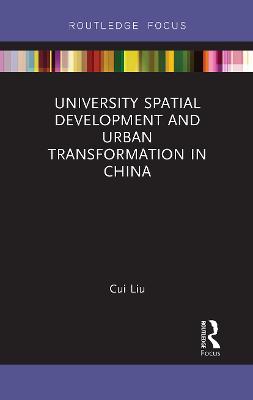
University Spatial Development and Urban Transformation in China [Minkštas viršelis]

  • Formatas: Paperback / softback, 148 pages, aukštis x plotis: 216x138 mm, weight: 176 g, 9 Illustrations, black and white
  • Išleidimo metai: 29-Aug-2022
  • Leidėjas: Routledge
  • ISBN-10: 1032402148
  • ISBN-13: 9781032402147
Kitos knygos pagal šią temą:
  • Formatas: Paperback / softback, 148 pages, aukštis x plotis: 216x138 mm, weight: 176 g, 9 Illustrations, black and white
  • Išleidimo metai: 29-Aug-2022
  • Leidėjas: Routledge
  • ISBN-10: 1032402148
  • ISBN-13: 9781032402147
Kitos knygos pagal šią temą:
University Spatial Development and Urban Transformation in China explores the changing relationship between the university and the city from a spatial perspective.

The past few decades have seen universities take on a leading role in urban development, actively providing public services beyond teaching and research. The relationship between the university and the city has great influence on the space of university, which is vividly reflected in the process of university spatial development. This process has been particularly evident in China as Chinese universities and cities have been undergoing dramatic transformations since reform in the late 1970s.

University Spatial Development and Urban Transformation in China explores the changing relationship between the university and the city from a spatial perspective. Based on theories and discourses on the production of space, the book analyzes case studies in university spatial development in China at three scales – global, national and local – covering social and urban contexts, the urban transformation, interactions in the development process and the changing dynamic between university and city to propose mutually beneficial planning strategies.

This book is a valuable resource for academics, researchers and urban planners in identifying the key factors and relationships in university spatial development using theoretical and empirical data to guide future urban planning.

List of figures
vii
List of tables
viii
Acknowledgements ix
Introduction 1(8)
PART I The spatial, temporal and social perspectives
9(26)
1 The evolution of universities in Chinese history: spatio-temporal perspectives
11(15)
2 The role of universities in the knowledge society: socio-spatial perspectives
26(9)
PART II The global, national and local scales
35(60)
3 Urban universities in the globalizing world
37(15)
4 University-city coalitions between the state and the market in China
52(23)
5 University development and urban restructuring in Shanghai
75(20)
PART III Case studies
95(25)
6 A top-down strategy for urbanization: Songjiang University Town
97(10)
7 A bottom-up strategy for urban renewal: Tongji Creative Cluster
107(13)
Conclusion 120(13)
Index 133
Cui Liu is a lecturer in architecture and urban design at the College of Civil Engineering and Architecture, Zhejiang University, China, and a professional architect and urban planner.